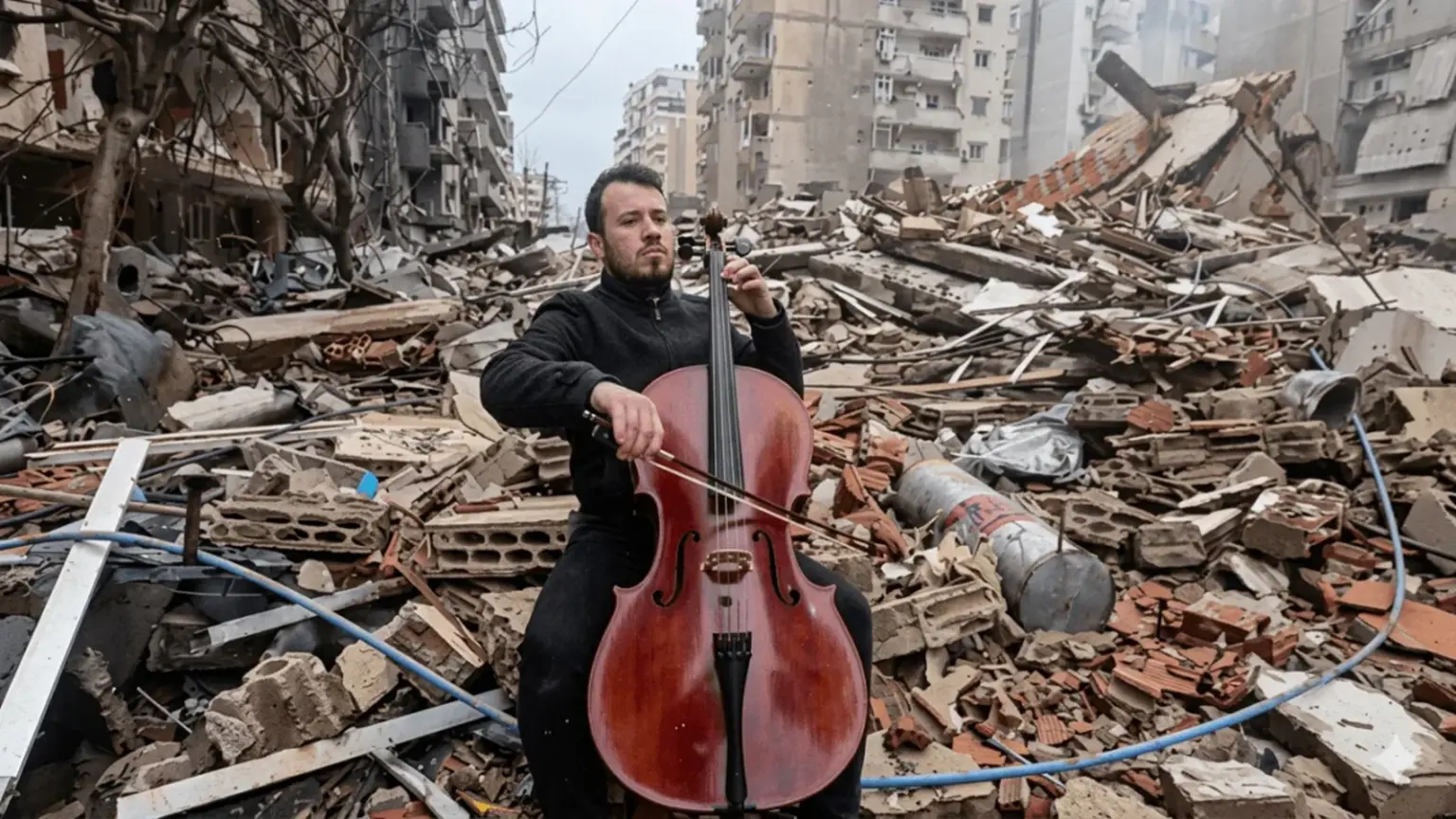
Lebanese cellist Mahdi Al Sahily has been playing his cello in the devastated suburb of Haret Hreik, Beirut, for several weeks. The area, known for its affiliation with Hezbollah, has seen extensive destruction due to Israeli strikes. Al Sahily, 30, consistently dressed in black, performs daily in what he refers to as one of his favored neighborhoods, surrounded by the remnants of buildings and debris.
Featuring works by Armenian composer Aram Khachaturian, Al Sahily’s signature piece is the ‘Andantino.’ This composition, historically criticized by Soviet authorities for its lack of nationalism, now serves as a poignant blend of protest and mourning amidst the violence. His music stands as a testament to resilience in a world marred by conflict.
Responses to Militarization Through Music
In Pakdasht, Iran, approximately 50 kilometers southeast of Tehran, Iranian musician Ali Ghamsari seized the day to play the Persian tar on April 7, just moments after a warning from former U.S. President Donald Trump that implied imminent destruction. During this period, Ghamsari expressed defiance through his music while young activists formed human chains to protect vital energy and infrastructure facilities. A ceasefire was declared the following day, although the scenario posed questions about the fragility of peace.
The role of art during wartime often raises complex questions. Can creative expression seem inappropriate amid chaos? Many critique art as an escape, as survival concerns—food, clothing, shelter—prioritize urgency in conflict situations. Yet, as artists like Al Sahily and Ghamsari suggest, music serves a distinct purpose by fostering a sense of life and continuity even amid devastation.
Historical Context and Contemporary Parallels
Historical instances abound showcasing the significance of music in war zones. In 1992, Vedran Smailović, principal cellist of the Sarajevo Orchestra, famously transported a chair to a bombed market and played ‘Adagio in G Minor’ by Tomaso Albinoni in memory of 22 people who were lost during a shelling incident. Smailović returned to this site for 22 consecutive days to honor the deceased.
Similarly, in 2015, Karim Wasfi, a former director of the Iraqi National Symphony Orchestra, demonstrated musical resilience by playing his cello next to a bombed building in Baghdad. Music has emerged as a common refuge in the war-torn regions of Syria. In the aftermath of civil unrest following the death of Freddie Gray in Baltimore in 2015, members of the Baltimore Symphony Orchestra gathered to play Bach and Beethoven outside the concert hall, contributing cultural sustenance in a time of turmoil.
A striking image from the past depicts a Russian soldier playing an abandoned piano amidst the ruins of Chechnya in 1994, symbolizing the enduring nature of art in conflict. In Gaza, a music teacher has turned art into a survival mechanism for displaced children, adapting their songs to the sounds of nearby Israeli drones. According to the children, singing provides them with a sense of security amidst their fears.
Hope Amid Destruction
The tense atmosphere in Tehran on the morning following the U.S.-Iran ceasefire added to the complexity of the situation. Near a military base, musician Hamidreza Afarideh gathered in the ruins of his music school to play his kamancheh, creating a final melodic memory in a context filled with destruction. He shared his intention on social media: “I wanted the last sound that remains here to be music, not bombs and missiles.”
This narrative emphasizes the refusal of music to be silenced in the face of adversity, serving as a powerful reminder of the enduring spirit of creativity and resistance.