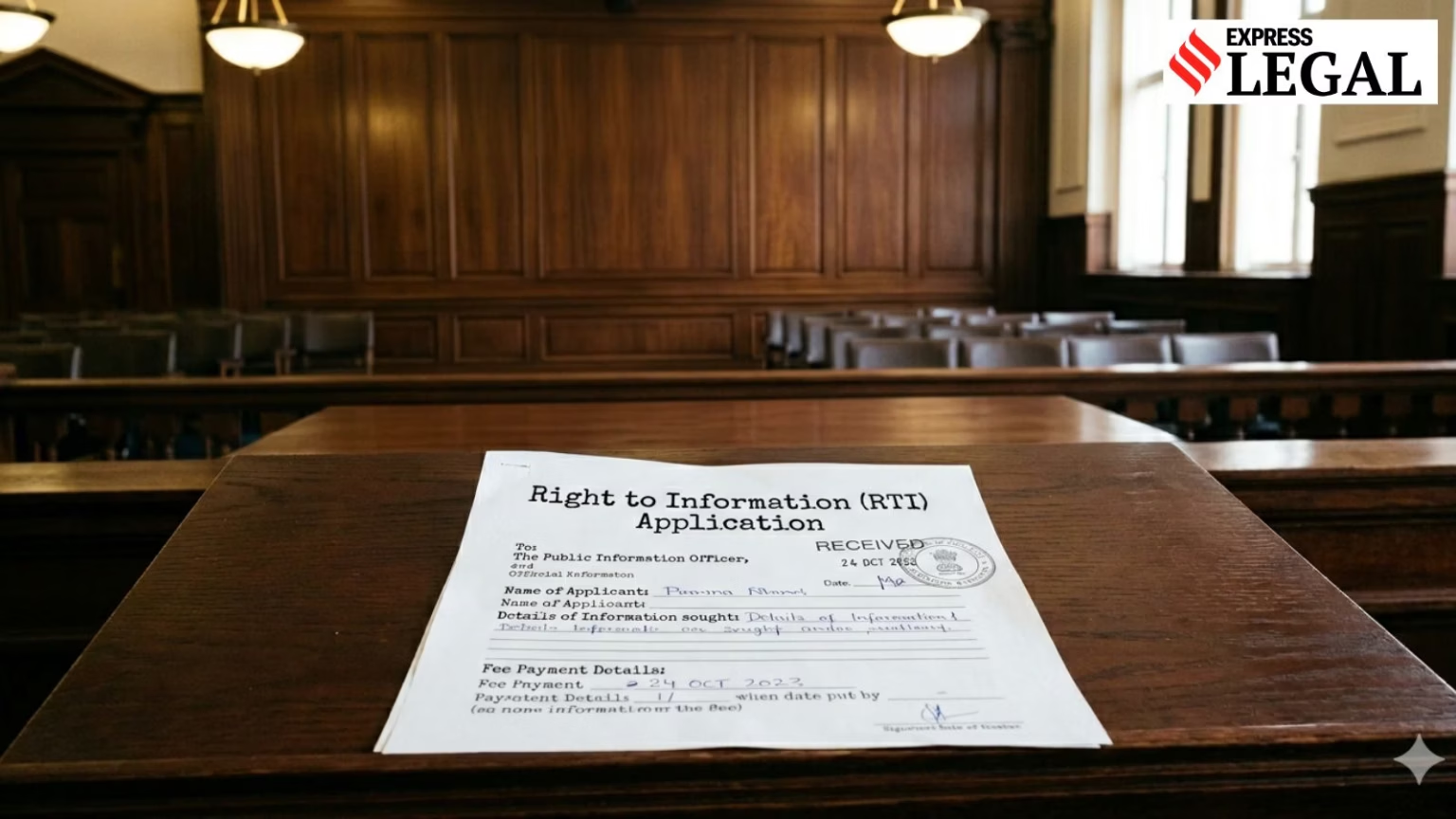
Allahabad High Court Denies Release of Higher Judicial Service Exam Answer Sheets Under RTI
Court’s Decision on Information Disclosure
The Allahabad High Court has overturned a directive from the Central Information Commission (CIC) that mandated the release of evaluated answer sheets from the UP Higher Judicial Service Examination conducted in 2009. The High Court emphasized the importance of confidentiality regarding judicial services exams, asserting that these examinations possess a unique sanctity that must be preserved.
During the session, a bench comprising Justices Ajit Kumar and Indrajeet Shukla remarked that while the Right to Information (RTI) Act promotes transparency, it cannot come at the cost of preserving the integrity of judicial examinations. The court’s order, delivered on April 17, highlighted that the examination process is significant and should maintain its confidentiality. It stated, “We find that the examination conducted to the High Court namely the Higher Judicial Services Examination are sacrosanct and confidentiality and sanctity has to be maintained even while ensuring transparency.”
Details of the Plea
The Allahabad High Court’s ruling came in response to an appeal challenging the CIC’s decision to disclose photocopies of evaluated answer sheets while concealing references to the examiners. The petitioner’s counsel argued that the RTI Act allows for disclosure of information pertaining to marks, suggesting that once the score is revealed, sufficient information is available for candidates.
The counsel further posited that if discrepancies arise between marks reflected in the tabulation sheets and those awarded in the answer sheets, candidates could seek clarification through access to their answer sheets. They also referenced the rules governing RTI applications, which stipulate that information should be provided if the request is based on a legitimate and lawful purpose and does not adversely impact the resources of the courts or the preservation of records.
The petitioner’s counsel also pointed out that the directive to provide the answer sheets, even with the removal of examiner identities, contradicted established practices regarding the availability of such documents in higher judicial service exams.
Arguments Presented in Court
The bench noted that although the RTI Act aims to foster transparency, there must be a balance with the need to maintain the confidentiality surrounding judicial examination processes. The judges underscored that providing access to answer sheets was not required, especially when there is no existing rule that mandates their disclosure. The court noted, “If any candidate has any grievance after perusing the answer sheets, such candidate can always put notes in his own diary for the purposes of further grievance in the matter, if he may so desire but providing the answer books is not necessary, more especially when the rules do not provide for the same.”
Moreover, the court articulated that there has been no pre-existing practice of distributing answer copies in higher judicial service examinations, thereby supporting its stance. The decision concluded with the High Court allowing the petition and quashing the CIC’s order to release the evaluated answer sheets.
Conclusion of the Ruling
The Allahabad High Court ultimately ruled in favor of preserving the confidentiality of the examination process, stating, “The writ petition succeeds and is allowed. The order dated April 04, 2013 passed by the Central Information Commission, New Delhi is hereby quashed.” This decision reinforces the notion that transparency in examination results must be weighed against the principles of confidentiality and integrity intrinsic to judicial examinations.