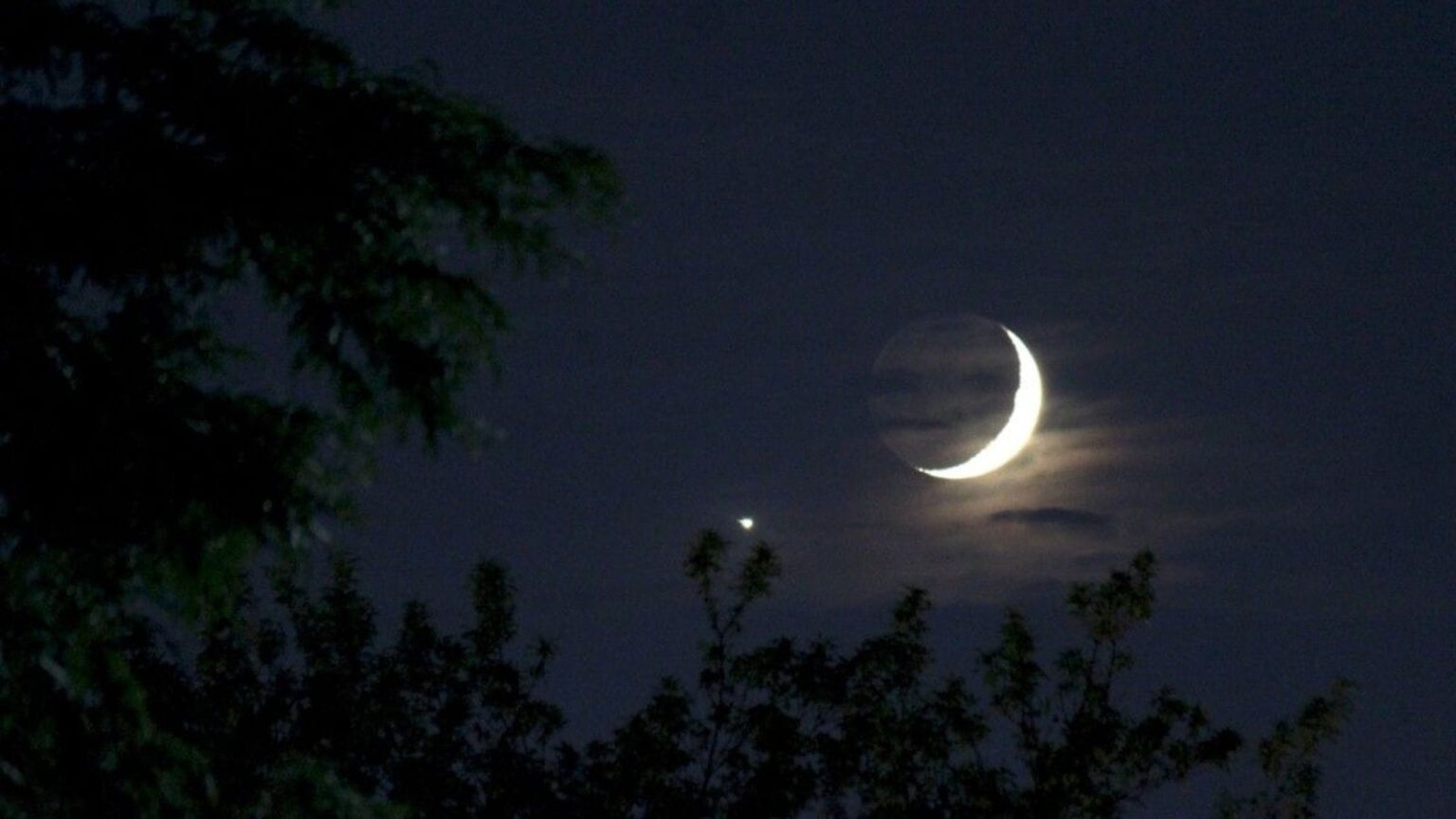
Venus and Crescent Moon to Align Tonight for Viewers
Viewing Conditions for Stargazers
On the evening of May 18, 2026, stargazers and sky observers have the opportunity to see Venus shining closely alongside a slender crescent moon. At this time, the moon will be 2.1 days past new, displaying only 7 percent illumination.
Although Venus and the moon are positioned far apart in space, their close appearance can captivate those looking up at the night sky. To gauge their proximity, observers can extend their arm with a clenched fist, measuring a span of 10 degrees. That evening, the moon will be located approximately three degrees to the right of Venus, or one-third of the fist-width gap.
Visibility and Brightness
Current observations indicate that Venus sets around 10:50 PM in local daylight time. This event marks a key period as Venus approaches its peak visibility in the evening sky during the second week of June, when it remains above the horizon until around 11 PM. After this, it gradually descends below the ecliptic plane from the observer’s viewpoint.
Despite common belief that Venus appears brighter than the moon, it is in fact the crescent moon that outshines Venus by a significant margin. Venus shines at a magnitude of 4.0, while the moon radiates light that is 17 times brighter. This perception results from the moon’s ability to spread its light over a larger area, leading to the misunderstanding of its luminosity compared to Venus, which is perceived as a sharp point of light.
Distance and Perspective
The optical illusion of proximity is somewhat misleading, as the moon and Venus are not close to each other in actual space. The moon is situated approximately 224,000 miles (360,000 kilometers) from Earth, while Venus is about 124 million miles away. However, the alignment on the evening of May 18 creates a unique visual where they appear near each other.
During the month of May, Venus continues to move further away from the Sun in a phenomenon termed elongation, increasing its angular separation by 24 to 32 degrees. For observers situated in the northern temperate latitudes, Venus is positioned about 25 degrees above the horizon, enhancing its visibility. As of 2026, it maintains a position 10 to 20 degrees east of the sun, supporting consistent visibility patterns historically recorded.
Telescope Observations
The twilight sky during this period can benefit those hoping to view Venus through a telescope, as the illumination can reduce glare. Although Venus is currently in its gibbous phase—where seven-eighths of its surface is illuminated—it may appear less prominent to observers.
This celestial event offers a prime opportunity for sky enthusiasts to enjoy the beauty of the night sky and gain a better understanding of planetary visibility. Interested viewers are encouraged to set their sights on the skies this evening to witness Venus and the crescent moon in alignment.