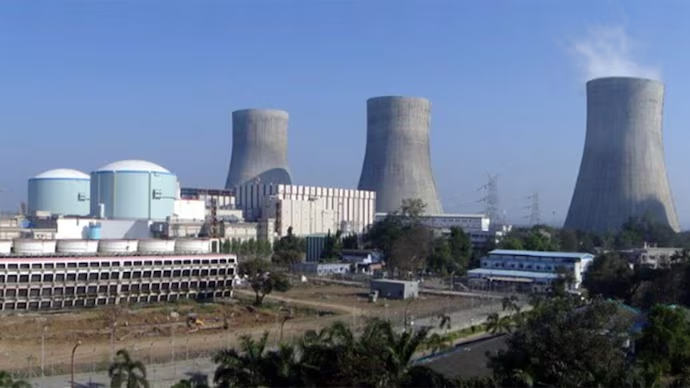
Milestone Achievement in India’s Nuclear Energy Program
Significant Developments in Nuclear Energy
The achievement of criticality in the Prototype Fast Breeder Reactor in Kalpakkam, Tamil Nadu, represents a significant milestone for India’s nuclear energy sector. This event is viewed as a pivotal point in the evolution of India’s nuclear energy initiatives, aligning with the vision set forth by the pioneers of the nation’s atomic energy program over seventy years ago.
Fast breeder reactors present considerable engineering challenges compared to the Pressurised Heavy Water Reactors that form the backbone of India’s current nuclear infrastructure. However, this advancement is not solely about technological achievement; it is an important progression in India’s strategic pursuit of energy independence and autonomy. The onset of the second stage of the country’s three-stage nuclear program is crucial for sustainable energy security in the decades ahead.
Nuclear Energy’s Shift in Perception
Nuclear energy, once viewed with skepticism due to safety concerns, is increasingly recognized as a vital source of reliable and clean energy. This recognition arises amid a global shift towards reduced reliance on fossil fuels, positioning nuclear energy as essential for meeting escalating energy demands. In India, the significance of nuclear power is underscored by its potential to lessen reliance on energy imports, thereby minimizing vulnerability to external pressures.
India’s nuclear program also faces challenges regarding its fuel supply. The primary fuel, uranium, is not sufficiently available within the country, leading to dependence on international sources. The foresight of Homi Bhabha and his contemporaries is reflected in the establishment of a three-stage nuclear energy strategy, with the third stage focusing on utilizing thorium as fuel, which is abundant in India.
Progress and Challenges Ahead
The journey towards realizing the three-stage pathway has not been straightforward. The initial test fast breeder reactor was constructed only in the early 2000s, and there have been periods where the focus appeared to wane. Nonetheless, the recent attainment of criticality at the Kalpakkam facility is expected to reinvigorate efforts towards achieving the goals set out in this ambitious nuclear energy framework.
The developments in Kalpakkam signify a broader commitment to expanding India’s nuclear capabilities. Initiatives such as the establishment of a dedicated nuclear energy mission, the enactment of the SHANTI Act, and the promotion of Small Modular Reactors (SMRs) demonstrate the government’s proactive approach. Furthermore, the recent opening of the nuclear sector to private investment is anticipated to enhance innovation and efficiency within this vital energy domain.
Overall, these efforts illustrate India’s serious engagement with its nuclear energy sector, aiming for significant advancements that could reshape its energy landscape in the near future. The integration of state-led initiatives with private participation may pave the way for a new era in nuclear energy development in India.