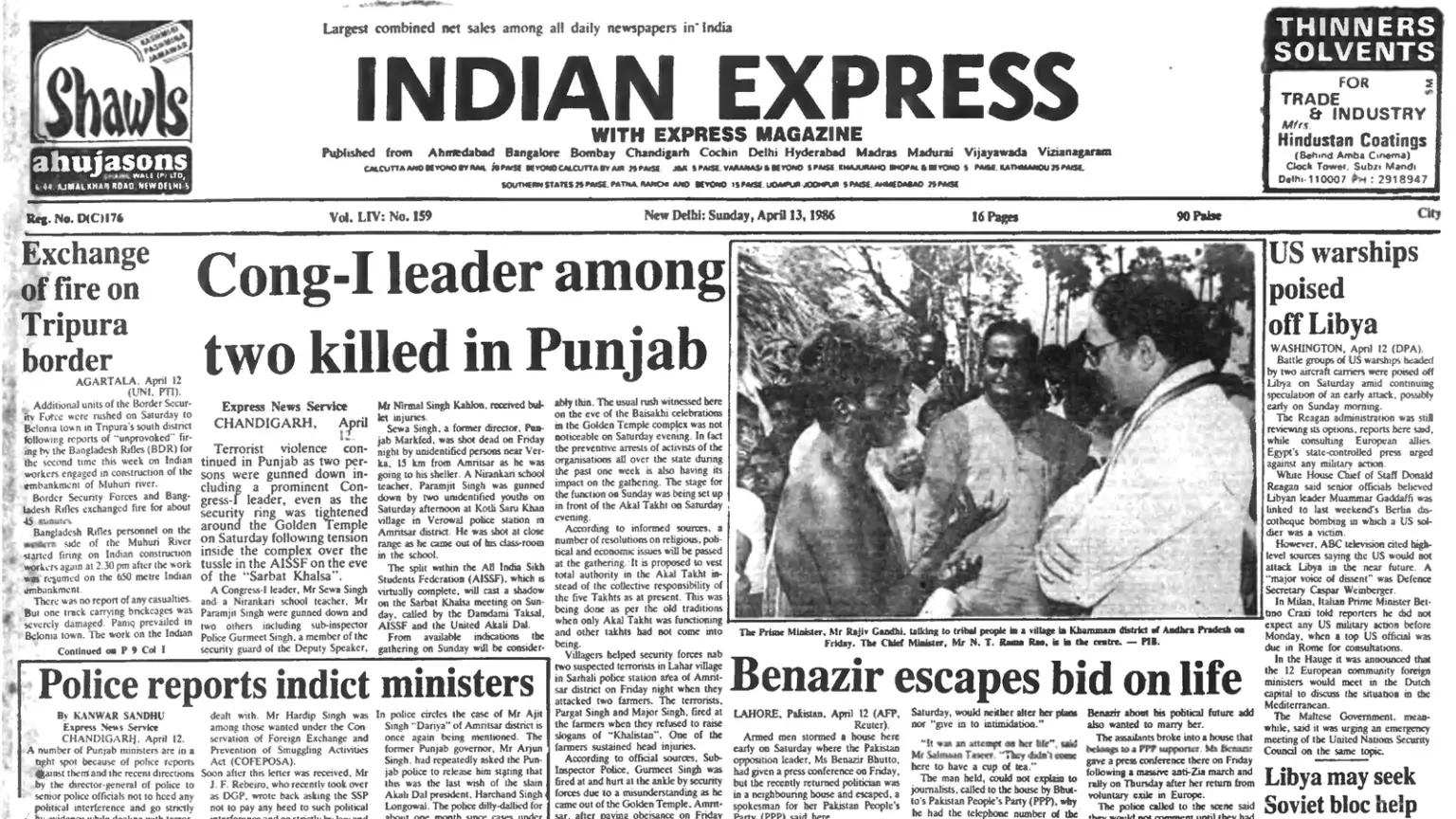
On April 13, 1986, US battle groups, led by two aircraft carriers, were positioned off the coast of Libya, heightening speculation regarding a potential military strike. The Reagan administration was reportedly in the process of evaluating various options while maintaining consultations with its European allies. Concurrently, Egyptian state media was advocating against any military intervention in the region.
White House Chief of Staff Donald Reagan stated that senior officials in Washington implicated Libyan leader Muammar Gaddafi in a recent bombing at a Berlin discotheque, which had resulted in the death of a US service member.
Violence in Punjab
In Punjab, the ongoing issue of terrorist violence claimed the lives of two individuals, including a notable Congress-I leader. The situation led to heightened security measures around the Golden Temple as tensions flared within the complex, primarily driven by internal disputes among members of the All-India Sikh Students’ Federation (AISSF) on the eve of the “Sarbat Khalsa” gathering. Those killed were identified as Sewa Singh, a Congress-I leader, and Paramjit Singh, a teacher associated with the Nirankari school. Additionally, two other individuals sustained bullet injuries during the incidents.
Soviet Nuclear Testing News
In international news, the Soviet ambassador to the United Nations announced that the Soviet Union might resume nuclear weapons testing “at any moment.” Ambassador Yuri Dubinin made this declaration during a news conference where he outlined the Soviet rationale for lifting a self-imposed moratorium on nuclear tests, citing ongoing United States test explosions as a contributing factor. Furthermore, Dubinin reiterated the Soviet proposal for a meeting between President Reagan and Soviet leader Gorbachev, aimed specifically at negotiating a nuclear test ban.
Political Climate at Kumbh Mela
This year’s Kumbh Mela in Haridwar has been marked by significant political undertones. The discourses taking place within various ashrams and akhadas are reflective of the recent socio-political developments over the past decade. Participants, including pandits and gurus from diverse regions of India, are addressing multiple facets of Hinduism in their discussions, thereby infusing the religious event with a notable political flavor.