

Artemis II Splashdown Marks a Historic Return in Human Space Travel
Mission Overview
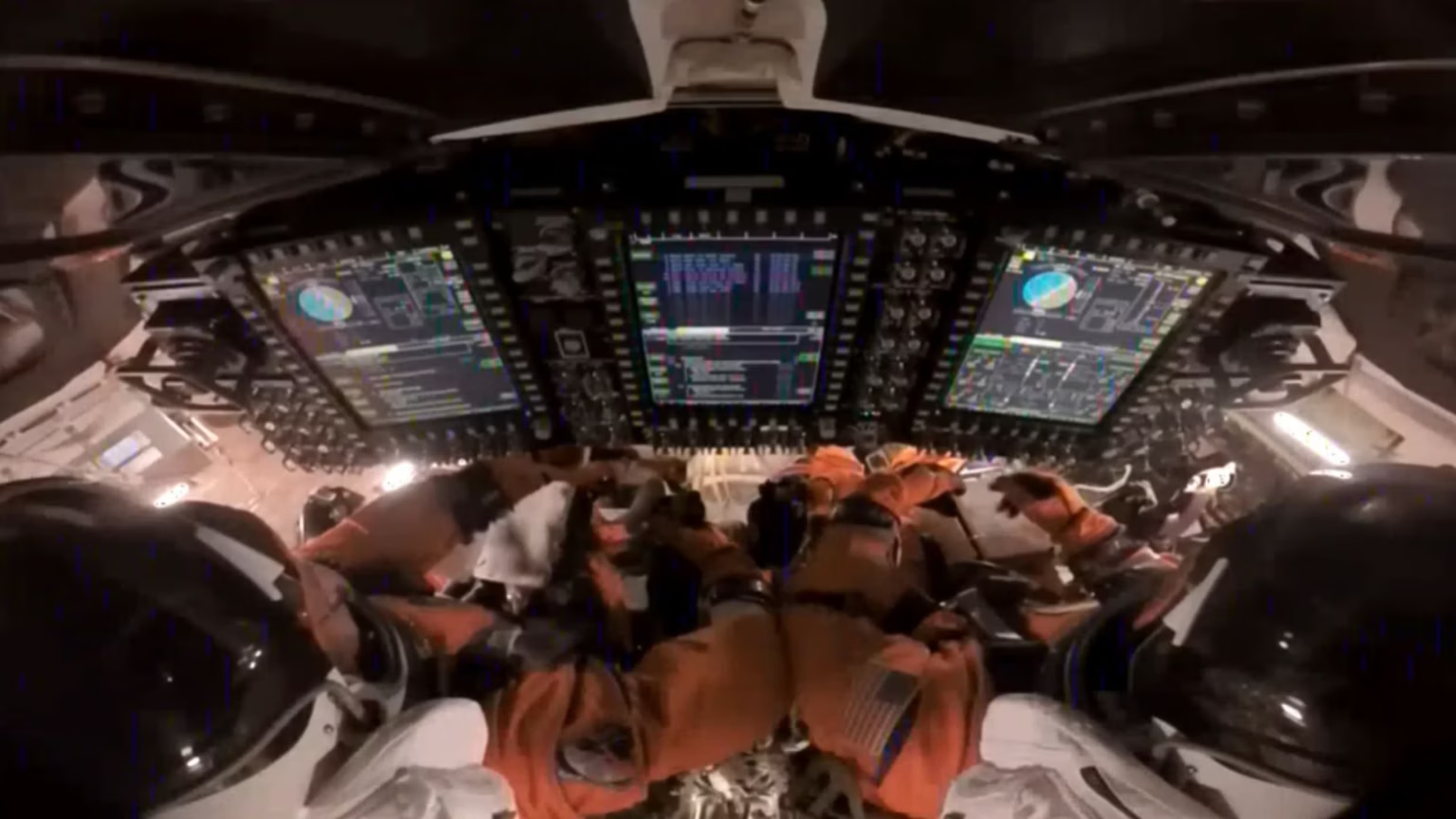
The Artemis II crew, consisting of NASA astronauts Reid Wiseman, Victor Glover, and Christina Koch, along with Canadian Space Agency astronaut Jeremy Hansen, has successfully returned to Earth aboard the Orion spacecraft. After a significant journey that took them around the Moon, they landed in the Pacific Ocean off the southern California coast shortly after 5 AM IST on Saturday.
This marks a milestone as the crew became the first humans to venture near the Moon in over fifty years. Although they did not land on the Moon, their mission trajectory allowed them to reach the farthest point in space ever achieved by humans, surpassing even the distances traveled during the Apollo missions of the 1960s and 1970s.
Distance Traveled
During their 10-day journey, the Artemis II mission covered a total distance of 694,481 miles (approximately 1.12 million kilometers). This distance, while significant, is less than the 1.48 million miles (around 2.38 million kilometers) traveled by the Apollo 17 mission, the final Apollo mission. The average distance from the Earth to the Moon is approximately 384,400 kilometers, suggesting that a round trip would typically involve at least 768,800 kilometers.
It is important to note that the actual distance traveled during space missions can vary due to complex trajectories. Both the Earth and Moon are in elliptical orbits, which can alter the distance between them throughout the mission. Factors such as time spent in lunar and Earth orbits and the particular geometry of the Earth-Moon system also play a role in determining the total distance covered.
Re-Entry Process
As the Orion spacecraft prepared for re-entry, it was traveling at speeds of approximately 11-12 kilometers per second (about 40,000 to 42,000 kilometers per hour). This speed significantly exceeds the re-entry speeds of vehicles returning from the International Space Station (ISS), which typically range from 26,000 to 28,000 kilometers per hour. The higher velocities are due to the increased gravitational influence experienced by spacecraft returning from the Moon, as they spend more time under Earth’s gravity before re-entering the atmosphere.
The re-entry process required the Orion spacecraft to withstand the intense physical stresses associated with higher speeds. The ISS is situated around 400 kilometers above Earth, while the Moon is located nearly 400,000 kilometers away, leading to greater acceleration for lunar-bound missions.
Safe Splashdown
Upon entering the atmosphere, the Orion spacecraft deployed a series of parachutes to facilitate a safe landing. The first set of parachutes was activated at an altitude of approximately 6 kilometers, followed by another deployment at around 2 kilometers above the surface. By this point, the spacecraft had decelerated to a speed of about 200 kilometers per hour, ultimately splashing down at around 30 kilometers per hour.
Rescue teams from NASA and the United States military were positioned at multiple locations around the landing site to ensure the crew’s extraction after splashdown and their subsequent transport to a nearby ship.
Future of the Artemis Program
The successful completion of the Artemis II mission sets the stage for NASA’s first human Moon landing in over five decades, currently planned for 2028. Artemis II is the inaugural crewed mission in NASA’s Artemis program, which aims to return humans to the Moon more than fifty years after the Apollo program successfully landed twelve astronauts on the lunar surface during six historic missions.
The initial mission of the Artemis program in 2022 involved an uncrewed spacecraft orbiting the Moon and returning to Earth. Artemis II has effectively served as a dress rehearsal for the upcoming Moon landing in 2028, marking the beginning of a new era in human spaceflight, focused on establishing a permanent presence on the Moon and facilitating regular human travel to its surface.
Follow US
https://www.facebook.com/charchaexpress
https://www.youtube.com/@charcha-express
https://www.instagram.com/charcha.express/
Contents
Mission OverviewThe Artemis II crew, consisting of NASA astronauts Reid Wiseman, Victor Glover, and Christina Koch, along with Canadian Space Agency astronaut Jeremy Hansen, has successfully returned to Earth aboard the Orion spacecraft. After a significant journey that took them around the Moon, they landed in the Pacific Ocean off the southern California coast shortly after 5 AM IST on Saturday.This marks a milestone as the crew became the first humans to venture near the Moon in over fifty years. Although they did not land on the Moon, their mission trajectory allowed them to reach the farthest point in space ever achieved by humans, surpassing even the distances traveled during the Apollo missions of the 1960s and 1970s.Distance TraveledDuring their 10-day journey, the Artemis II mission covered a total distance of 694,481 miles (approximately 1.12 million kilometers). This distance, while significant, is less than the 1.48 million miles (around 2.38 million kilometers) traveled by the Apollo 17 mission, the final Apollo mission. The average distance from the Earth to the Moon is approximately 384,400 kilometers, suggesting that a round trip would typically involve at least 768,800 kilometers.It is important to note that the actual distance traveled during space missions can vary due to complex trajectories. Both the Earth and Moon are in elliptical orbits, which can alter the distance between them throughout the mission. Factors such as time spent in lunar and Earth orbits and the particular geometry of the Earth-Moon system also play a role in determining the total distance covered.Re-Entry ProcessAs the Orion spacecraft prepared for re-entry, it was traveling at speeds of approximately 11-12 kilometers per second (about 40,000 to 42,000 kilometers per hour). This speed significantly exceeds the re-entry speeds of vehicles returning from the International Space Station (ISS), which typically range from 26,000 to 28,000 kilometers per hour. The higher velocities are due to the increased gravitational influence experienced by spacecraft returning from the Moon, as they spend more time under Earth’s gravity before re-entering the atmosphere.The re-entry process required the Orion spacecraft to withstand the intense physical stresses associated with higher speeds. The ISS is situated around 400 kilometers above Earth, while the Moon is located nearly 400,000 kilometers away, leading to greater acceleration for lunar-bound missions.Safe SplashdownUpon entering the atmosphere, the Orion spacecraft deployed a series of parachutes to facilitate a safe landing. The first set of parachutes was activated at an altitude of approximately 6 kilometers, followed by another deployment at around 2 kilometers above the surface. By this point, the spacecraft had decelerated to a speed of about 200 kilometers per hour, ultimately splashing down at around 30 kilometers per hour.Rescue teams from NASA and the United States military were positioned at multiple locations around the landing site to ensure the crew’s extraction after splashdown and their subsequent transport to a nearby ship.Future of the Artemis ProgramThe successful completion of the Artemis II mission sets the stage for NASA’s first human Moon landing in over five decades, currently planned for 2028. Artemis II is the inaugural crewed mission in NASA’s Artemis program, which aims to return humans to the Moon more than fifty years after the Apollo program successfully landed twelve astronauts on the lunar surface during six historic missions.The initial mission of the Artemis program in 2022 involved an uncrewed spacecraft orbiting the Moon and returning to Earth. Artemis II has effectively served as a dress rehearsal for the upcoming Moon landing in 2028, marking the beginning of a new era in human spaceflight, focused on establishing a permanent presence on the Moon and facilitating regular human travel to its surface.